Where Biller Fits in the New Generation of AI-Powered Restaurant Software
Published
For years, restaurant software in India has largely been built around one job: billing.
Create an order. Print a KOT. Generate a GST invoice. Close the bill.
Those things still matter. In fact, they are non-negotiable.
But restaurant owners today need much more from their software.
They need to know what is selling, what is running out, which ingredients are being consumed, what needs to be reordered, how their outlets are performing, and increasingly, what they should do next.
That is where a new generation of restaurant software is emerging: products that combine the traditional POS with automation, data, and AI.
Biller is being built for this shift.
From billing software to restaurant operating software
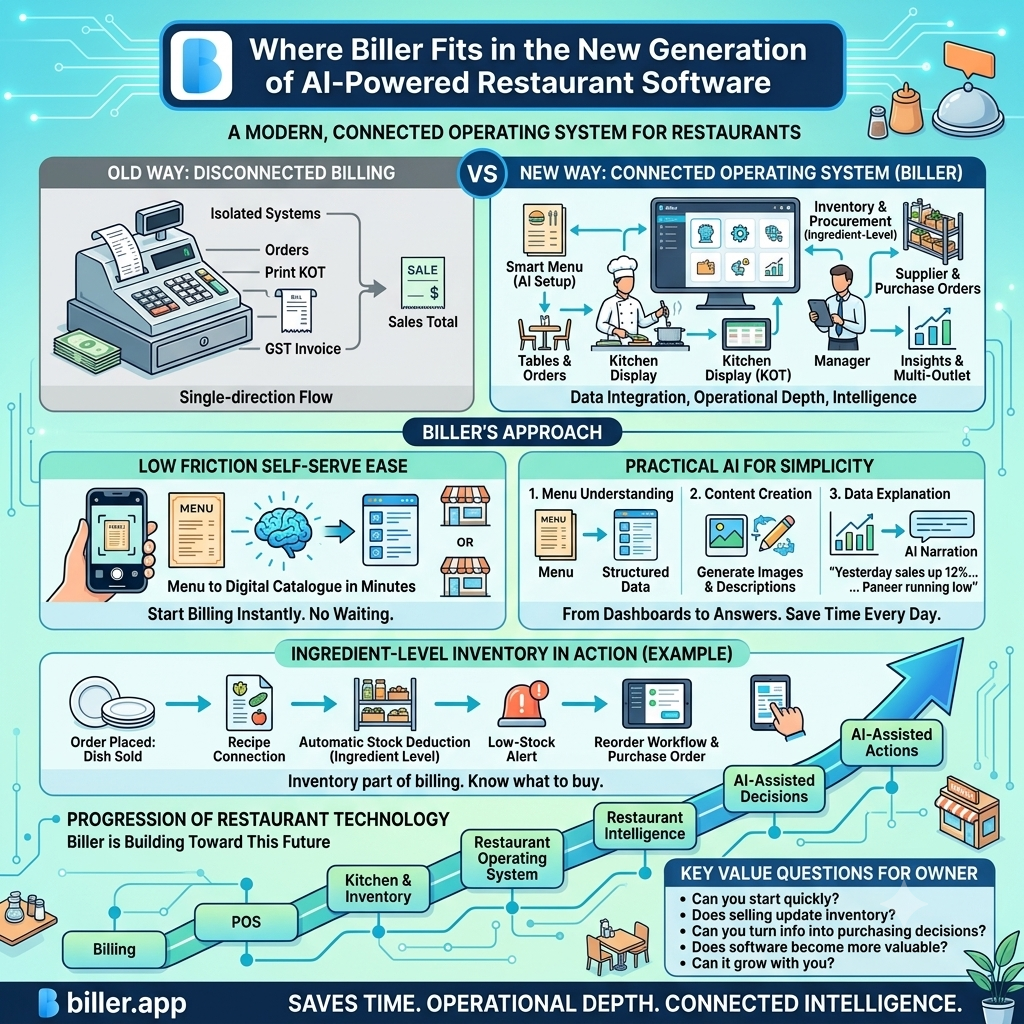
The most useful way to think about modern restaurant software is not as a billing machine, but as a system connecting the different parts of a restaurant.
A typical restaurant has:
- A menu
- Orders
- Tables
- Kitchen operations
- Bills and GST
- Ingredients
- Inventory
- Suppliers
- Customers
- Staff
- Multiple outlets
- Daily sales data
Traditionally, much of this information has lived in separate systems, spreadsheets, notebooks, or people's heads.
The opportunity with modern software is to connect these pieces.
Biller brings billing, KOT, kitchen operations, ingredient-level inventory, procurement, multi-outlet management and business insights into one system, while using AI where it can remove manual work or make the data easier to understand.
That distinction is important.
AI should not be a feature added to a POS simply because AI is popular.
It should make running the restaurant simpler.
What makes the emerging restaurant software category different?
There are several interesting players building the next generation of restaurant technology in India.
Some are approaching the market through AI-powered analytics.
Some are building complete restaurant operating systems.
Some are focusing on mobile-first POS.
Others are trying to make onboarding and setup dramatically easier.
Biller takes a slightly different approach:
Make restaurant software easy enough to start without a salesperson, while making it powerful enough to become part of the restaurant's daily operations.
That leads to two principles behind the product.
- Getting started should be easy.
- The software should become more useful as the restaurant uses it.
The first problem: restaurant software takes too long to set up
One of the least interesting parts of running a restaurant is also one of the biggest barriers to adopting software: entering the restaurant's data.
A restaurant may already have a physical menu containing dozens or hundreds of items.
Why should someone manually enter every item, price and category into a POS?
With Biller, a restaurant can photograph its menu and use AI to turn it into a reviewable digital catalogue.
That means the starting point isn't:
"Spend the afternoon configuring your POS."
It can be:
"Show Biller your menu."
This is more than a convenience feature.
It represents a different philosophy about restaurant software:
The software should adapt to the restaurant, rather than forcing the restaurant to adapt to the software.
From menu to running restaurant
Once the catalogue is created, Biller moves beyond setup.
A restaurant can use Biller for:
- POS billing
- GST-compliant invoices
- Dine-in and table management
- KOT
- Live kitchen display
- Waiter and team roles
- WhatsApp bill sharing
- Multi-outlet management
- Sales reporting
- Ingredient-level inventory
- Recipe-based stock deduction
- Low-stock alerts
- Reorder lists
- Supplier management
- Purchase orders
This is where the distinction between a billing application and a restaurant operating system starts to disappear.
A dish isn't just a line item on a bill.
It can be connected to the ingredients required to make it.
A sale isn't just revenue.
It can become an input into inventory and business insights.
A low-stock warning isn't just a notification.
It can become the beginning of a purchase workflow.
Ingredient-level inventory changes the equation
Consider a simple example.
A restaurant sells 50 plates of Paneer Butter Masala.
A basic POS knows:
50 Paneer Butter Masala sold.
But restaurant operations need another question answered:
What did those 50 sales consume?
With ingredient-level inventory, a dish can be connected to its recipe.
Selling the dish can therefore deduct the relevant quantities of ingredients from inventory.
This creates a chain:
Order → Recipe → Ingredient consumption → Stock → Reorder
Biller also provides low-stock alerts, reorder lists, supplier records and purchase-order workflows.
That makes inventory a part of the billing system rather than a completely separate activity.
The next step: from inventory to procurement
Knowing that stock is low is useful.
Knowing what to buy is better.
Biller can turn inventory requirements into reorder lists, including quantities adjusted to practical buying units, and provides supplier and purchase-order workflows.
The goal is simple:
Reduce the amount of manual work between discovering a stock problem and doing something about it.
This is an important direction for restaurant software.
The best systems won't simply tell owners what happened.
They will progressively help owners act on it.
Where AI becomes genuinely useful
There is a temptation in software to put an "AI" label on every feature.
We think restaurant AI should be more practical.
There are three areas where it can already make a difference.
1. AI can understand the menu
A photograph of a physical menu can become structured restaurant data.
That can reduce setup time and eliminate repetitive data entry.
2. AI can create restaurant content
Biller can use AI to help generate menu images and descriptions, reducing another layer of manual work when a restaurant is digitising its menu.
3. AI can explain restaurant data
Once a restaurant is processing its sales and inventory data through the system, that data becomes useful for more than reports.
Biller provides a daily sales and inventory narrative designed to turn numbers into a plain-language summary.
Instead of requiring an owner to interpret every chart, the software can surface what deserves attention.
This is an important shift:
From dashboards to answers.
But AI forecasting is not the whole story
Some restaurant platforms are already moving toward predictive forecasting.
That is an important direction, and it is one Biller expects to explore further.
But there is a difference between predicting something and being able to act on it.
A future restaurant system should ideally be able to move through a sequence like this:
What happened?
→ Sales and operational insights
Why did it happen?
→ Analysis
What is likely to happen next?
→ Forecasting
What should I do?
→ Recommendation
Can you prepare it for me?
→ Automated action
That is the longer-term opportunity for AI in restaurant software.
Biller's approach: self-serve first
There is another important part of Biller's positioning that can easily be overlooked.
Biller is designed to be self-serve.
A restaurant does not have to begin by arranging a sales meeting or waiting for someone to install the system.
It can start online, set up its restaurant and begin exploring the product.
For restaurants that want assistance, a demo or setup call can still be arranged.
This creates a useful middle ground.
Product-led for simplicity.
Human-assisted when necessary.
That matters particularly for India's large base of independent restaurants, cafés, QSRs and growing small restaurant groups.
A restaurant with one outlet should not have to buy enterprise software just because it wants professional billing and inventory.
At the same time, a restaurant that grows from one outlet to several should not have to abandon its software simply because it started with a simple setup.
Why self-serve matters
Traditional software sales often look like this:
Lead → Demo → Negotiation → Installation → Training → Go live
A self-serve product can potentially make the journey:
Sign up → Import menu → Configure → Bill
That is a major difference.
It means the product itself becomes part of customer acquisition.
And when a restaurant needs help, assistance can be provided at the point where it is actually useful.
For example:
A restaurant uploads its menu but doesn't complete setup.
Instead of treating that person as just another sales lead, a restaurant software company can understand where they stopped and offer help.
That creates a different kind of sales model:
Use the product to identify intent, then use people where people add the most value.
Does self-serve mean there is no role for sales?
Not at all.
In fact, the best long-term model for restaurant software may be a combination of product-led growth and assisted sales.
A small restaurant may happily configure itself.
A growing restaurant with several outlets may want someone to help with:
- Migration
- Outlet configuration
- Inventory setup
- Staff permissions
- Hardware
- Integrations
- Training
- Reporting
The software can acquire and activate customers.
People can help larger or more complex customers get more value from it.
That is a much more scalable model than requiring every restaurant to go through a sales process before it can even try the product.
Where Biller fits among emerging restaurant software
The emerging restaurant software market is not one-dimensional.
Different products are making different bets.
Some focus on extremely low-cost billing.
Some focus on AI analytics.
Some are building broad restaurant operating systems.
Some are focused on enterprise chains.
Biller sits in an interesting part of this landscape:
AI-assisted, self-serve restaurant software for independent restaurants and growing SMB restaurant groups.
The focus is not to replace every enterprise restaurant platform.
It is to make sophisticated restaurant technology accessible without making implementation itself a project.
That means three things matter particularly strongly:
Low friction
A restaurant should be able to start quickly.
Operational depth
The product needs to go beyond billing into kitchen, inventory and procurement.
Intelligence
As the restaurant generates more data, the software should become more useful.
What Biller does not try to pretend today
Being ambitious about AI does not mean pretending every future capability already exists.
There are areas where established restaurant software still has advantages.
For example, mature platforms can have deeper integrations, longer-established offline workflows, larger support networks, or more extensive enterprise functionality.
Biller is still developing in these areas.
Swiggy and Zomato aggregator integrations are not currently part of the shipped product, and e-invoicing is still on the roadmap.
Predictive forecasting is also a future direction rather than something Biller claims to have already solved.
Being transparent about these boundaries is important.
The goal isn't to claim that a young product already does everything.
The goal is to build the right foundation.
The bigger opportunity: software that helps run the restaurant
Imagine what the next generation of restaurant software could look like.
An owner opens the application in the morning.
Instead of opening five reports, they see:
Yesterday's sales were up 12%.
Food cost increased because of higher ingredient consumption in three dishes.
Paneer stock is likely to run out tomorrow.
Your weekly reorder list is ready.
Your highest-margin dish is selling less than usual.
Outlet 2 is performing 9% below its recent average.
And instead of stopping there, the system can increasingly help prepare the next action.
A purchase order.
A menu change.
A promotion.
A staffing recommendation.
A customer message.
The restaurant owner remains in control.
But the software does more of the analytical and administrative work.
From POS to an AI operating layer
This is the direction we believe restaurant software is heading.
The progression looks something like this:
Billing
↓
POS
↓
Inventory + Kitchen
↓
Restaurant operating system
↓
Restaurant intelligence
↓
AI-assisted decisions
↓
AI-assisted actions
Biller is building toward that progression.
The POS is the foundation.
The restaurant's operational data is the connective tissue.
AI is the layer that can increasingly make that information understandable and actionable.
What should a restaurant owner look for?
When evaluating modern restaurant software, the question shouldn't simply be:
"How many features does it have?"
Instead, ask:
Can I get started without a complicated implementation?
Can my staff actually use it during a busy service?
Does billing connect to the kitchen?
Does selling a dish update ingredient inventory?
Can I turn inventory information into purchasing decisions?
Can I understand my business without studying spreadsheets?
Does the software become more valuable as my restaurant generates more data?
Can it grow from one outlet to multiple outlets?
And perhaps the most important question:
Does the software save me time every day, or does it simply give me another dashboard to manage?
That is the standard we think modern restaurant software should meet.
The Biller position
Biller isn't trying to make restaurant software more complicated.
It is trying to make it simpler to start and more useful over time.
Start with a menu.
Turn it into a digital catalogue.
Start billing.
Connect the kitchen.
Track ingredients.
Manage inventory.
Organise purchasing.
Understand sales.
Use AI to surface what matters.
And, over time, turn those insights into actions.
That is the opportunity we see in the next generation of restaurant technology in India.
The future of restaurant software isn't just about generating the bill.
It's about helping the restaurant understand what happened, what happens next, and what to do about it.
And that is where Biller is building.